
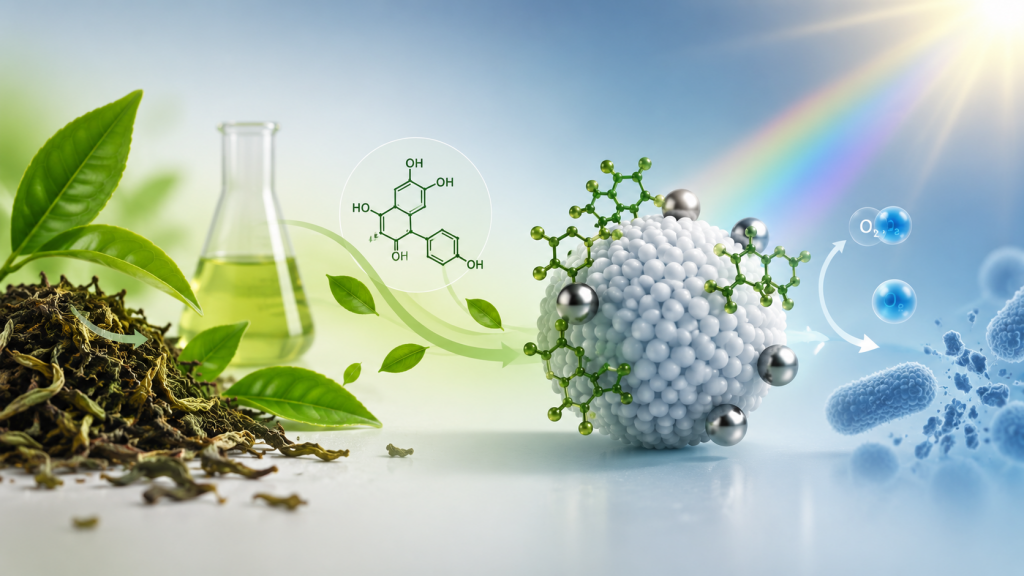
Green tea-derived ligands and silver enable controlled redox activity and enhanced antimicrobial performance
We are pleased to announce a new scientific publication supported by the HYDIS project – Multifunctional visible light-responsive inorganic-organic hybrids for efficient hydrogen production and disinfection.
The article “Interfacial Redox Engineering of TiO₂ Nanocomposites Using Green Tea-Derived Ligands and Silver” has been published in the journal Molecules.
The study presents a sustainable approach to engineering multifunctional TiO₂-based nanomaterials by combining green tea waste-derived organic ligands with silver, creating hybrid materials with tunable optical, redox, and biological properties.
Key Findings
Green Tea Waste as a Functional Material
Green tea waste was used as a source of naturally occurring organic ligands capable of interacting with the TiO₂ surface and forming an organic–inorganic hybrid interface.
Enhanced Visible-Light Response
Epigallocatechin gallate (EGCG) introduced interfacial charge-transfer states that significantly extended the optical response of TiO₂. The apparent optical bandgap decreased from approximately 3.48 eV for pristine TiO₂ to 1.83 eV for TiO₂/EGCG.
Controlled Interfacial Redox Activity
EPR measurements revealed that green tea-derived surface ligands suppress excessive radical generation and promote radical-scavenging behavior. The incorporation of silver partially restores oxidative pathways, particularly under irradiation.
Enhanced Antimicrobial Performance
The developed TiO₂/GT/Ag nanocomposite, containing 5.1 wt% Ag, demonstrated the strongest overall antimicrobial activity among the investigated materials. Visible-light irradiation produced an additional enhancement particularly against Staphylococcus aureus.
From Sustainable Chemistry to Advanced Hybrid Materials
A particularly important aspect of the study is the transformation of green tea waste into a functional component of an advanced nanomaterial.
HPLC and DFT analyses showed that different molecules originating from green tea play complementary roles at the TiO₂ interface. While caffeine forms the most thermodynamically stable surface complex, EGCG produces much stronger electronic coupling with TiO₂, enabling interfacial charge transfer and visible-light absorption.
This demonstrates that the properties of hybrid photocatalytic materials can be controlled not only through their inorganic components, but also through the careful engineering of the molecular interface between organic ligands and the semiconductor surface.
Relevance to the HYDIS Project
These results directly contribute to the scientific objectives of HYDIS, which focuses on the development of multifunctional visible-light-responsive inorganic–organic hybrids for efficient hydrogen production and disinfection.
Understanding the relationship between surface chemistry, interfacial charge transfer, redox processes, visible-light response, and antimicrobial activity is essential for the rational development of the next generation of multifunctional photocatalytic materials.
The findings provide new insight into how bio-derived surface ligands and metallic components can be combined to tune the functionality of TiO₂-based hybrid systems.
International Research Collaboration
The research brought together scientists from:
Vinča Institute of Nuclear Sciences – University of Belgrade, Serbia
Slovak University of Technology in Bratislava, Slovakia
INEP – Institute for Application of Nuclear Energy, University of Belgrade, Serbia
Faculty of Technology and Metallurgy, University of Belgrade, Serbia
The study was supported by several research programmes, including the Science Fund of the Republic of Serbia through the PRISMA programme – HYDIS Project, Grant No. 5354.
Publication
Interfacial Redox Engineering of TiO₂ Nanocomposites Using Green Tea-Derived Ligands and Silver
Authors: Valentina Nikšić, Dušan Sredojević, Miriama Malček Šimunková, Andrea Pirković, Ana Milivojević, Vlasta Brezová and Vesna Lazić
Journal: Molecules
Volume: 31
Article: 3123
Published: 6 September 2026
Open Access: CC BY
READ THE FULL ARTICLE →